

في هذا المقال
Key Takeaways |
| Arabic has two written digit systems, Eastern (٠١٢٣٤٥٦٧٨٩) used across Egypt and the Gulf, and Western (0123456789) used across the Maghreb. |
| The ten core number words from واحد to عشرة carry almost every counting situation a beginner meets in speech, shopping, and travel. |
| Numbers 3 to 10 take the opposite gender of the noun they count, so masculine nouns pair with the ة form of the number. |
| Digits inside a number run left to right even though Arabic script itself runs right to left. |
| Compound numbers from 21 to 99 place the unit before the ten, so 25 is said as five and twenty. |
Numbers are the first real Arabic a learner uses outside a textbook, because prices, dates, addresses, and phone digits appear everywhere. Learning arabic numbers in arabic script and sound removes the single biggest barrier to reading a menu, a receipt, or a street sign.
Most beginners memorize ten words, stop there, and then freeze the moment a number sits beside a noun. The counting system attaches grammar to every digit, and that grammar is what separates a learner who recites numbers from one who uses them.
This guide covers the ten foundation words, both digit systems, the gender rule that confuses nearly every student, the teens, the tens, the hundreds, the ordinals, and the exact practice method that fixes all of it in memory.
Arabic Numbers in Arabic Script and Sound
Arabic expresses quantity through two separate layers that learners often mix together. One layer is the spoken word, such as خَمْسَة (khamsah), meaning five. The other is the written digit, such as ٥ or 5.
Both layers are correct Arabic, and both appear in daily life. A price tag in Cairo shows ٥, while the cashier says khamsah. Confusing the two is why some students can read a number but cannot say it.
The spoken forms belong to Modern Standard Arabic and carry across every Arab country. Dialects adjust pronunciation slightly, yet the written word stays identical from Morocco to Oman, which makes the standard forms the safest starting point.
Numeral Systems and Word Forms Compared
Keeping the two layers separate from day one prevents most early confusion. The table below shows how a single quantity appears in each layer.
Layer | Example for Five | How It Is Used |
| Eastern digit | ٥ | Printed on prices, dates, and documents in Egypt, the Levant, and the Gulf. |
| Western digit | 5 | Printed across Morocco, Algeria, Tunisia, and in most international contexts. |
| Written word | خَمْسَة (khamsah) | Used in formal writing, contracts, and whenever the number is spelled out. |
| Spoken form | khamsah | Used in conversation, classrooms, and broadcast media. |
Why Digits Run Left to Right
Arabic script flows from right to left, yet a written number such as ١٢٣ is read starting from the left, exactly as in English. The highest place value sits on the left and the ones place sits on the right.
This means a year such as ١٩٩٠ keeps the familiar order while the surrounding words reverse direction. Beginners who expect numbers to mirror the script misread dates and prices constantly during their first weeks.
Arabic 1 to 10 With Pronunciation and Translation
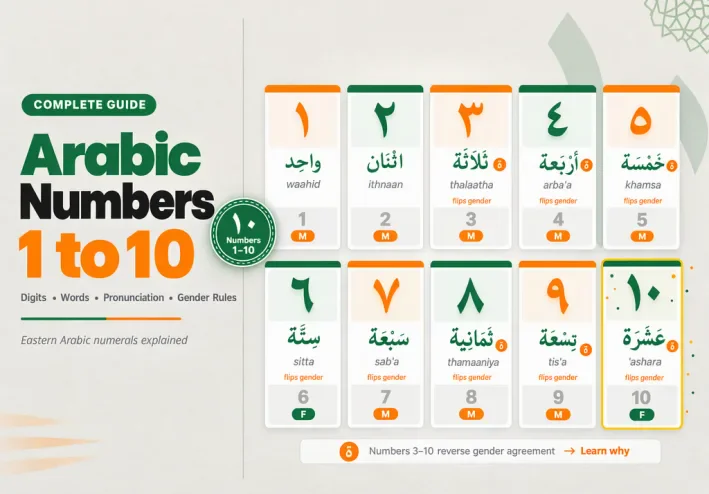
The ten base words below are the foundation of every larger number in the language. Each one appears here in its standard counting form, the form used when reciting numbers aloud or counting masculine nouns.
Digit | Eastern | Arabic Word | Pronunciation | English |
| 1 | ١ | وَاحِد | waahid | one |
| 2 | ٢ | اِثْنَان | ithnaan | two |
| 3 | ٣ | ثَلَاثَة | thalaathah | three |
| 4 | ٤ | أَرْبَعَة | arba'ah | four |
| 5 | ٥ | خَمْسَة | khamsah | five |
| 6 | ٦ | سِتَّة | sittah | six |
| 7 | ٧ | سَبْعَة | sab'ah | seven |
| 8 | ٨ | ثَمَانِيَة | thamaaniyah | eight |
| 9 | ٩ | تِسْعَة | tis'ah | nine |
| 10 | ١٠ | عَشَرَة | 'asharah | ten |
Zero completes the set and carries real historical weight. It is written صِفْر (sifr), meaning empty or vacant, and the English word cipher descends directly from it through medieval Latin translation.
Six of these ten words contain sounds that English speakers tend to flatten. The letter ث in ثَلَاثَة and ثَمَانِيَة is the unvoiced th of think, never the voiced th of this, and never a plain t in formal speech.
The doubled letters matter just as much. سِتَّة (sittah) holds the ت for an extra beat, and shortening it produces a different word entirely, so hold doubled consonants deliberately while practicing.
Eastern and Western Numerals Across the Arab World
Not every Arab country prints the same digits, and knowing which region uses which system saves confusion the moment you open a newspaper or a price list.
System | Digits | Where It Dominates |
| Eastern Arabic | ٠١٢٣٤٥٦٧٨٩ | Egypt, Saudi Arabia, the UAE, Jordan, Iraq, Syria, Palestine, Kuwait, Qatar, Bahrain, Oman, and Yemen. |
| Western Arabic | 0123456789 | Morocco, Algeria, Tunisia, Libya, and Mauritania. |
| Both in parallel | ٠-٩ and 0-9 | Lebanon and Sudan, where context decides which set appears. |
Both systems trace back to Indian mathematics and reached Europe through Arabic scholarship, which is why the digits used worldwide today still carry the name Arabic numerals.
Three Eastern digits regularly trip up new readers. The symbol ٥ resembles a Western zero, ٦ resembles a seven, and ٠ is a simple dot rather than an oval ring, so these three deserve extra drilling.
Arabic Numbers Handwriting Practice
Writing the digits by hand builds recognition faster than reading them on a screen. Copy ٠ through ٩ in order, then out of order, for five minutes daily across two weeks.
Pair each digit with its word as you write, saying waahid while forming ١. Linking the symbol, the sound, and the meaning in one action encodes all three together instead of as separate facts.
Gender Polarity Rule for Numbers 3 to 10
Arabic reverses gender agreement for numbers 3 through 10, which is the single most counterintuitive rule in the counting system. A masculine noun takes the number form ending in ة, and a feminine noun takes the form without it.
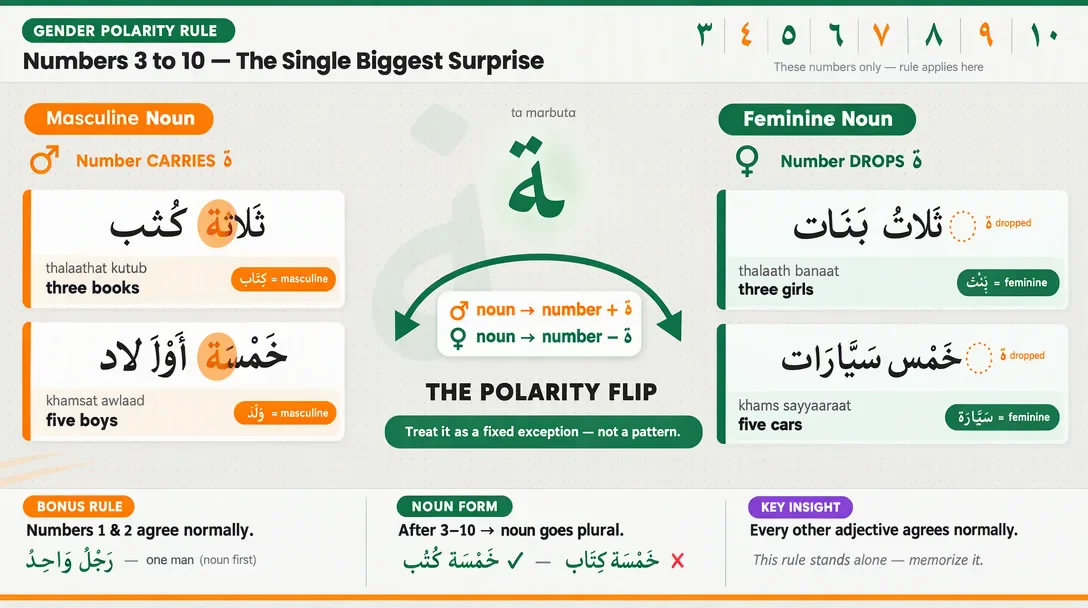
The logic feels backward because every other adjective in Arabic agrees normally. Treating this as a fixed exception rather than a pattern to reason through saves months of frustration.
Phrase | Pronunciation | Meaning | Why |
| ثَلَاثَة كُتُب | thalaathat kutub | three books | كِتَاب is masculine, so the number carries ة. |
| ثَلَاث بَنَات | thalaath banaat | three girls | بِنْت is feminine, so the number drops ة. |
| خَمْسَة أَوْلَاد | khamsat awlaad | five boys | وَلَد is masculine, so the number carries ة. |
| خَمْس سَيَّارَات | khams sayyaaraat | five cars | سَيَّارَة is feminine, so the number drops ة. |
Numbers 1 and 2 behave in the opposite way and agree normally with their noun. They also follow the noun rather than preceding it, as in رَجُلٌ وَاحِد (rajulun waahid), meaning one man.
The counted noun itself also shifts. After 3 to 10 it becomes plural, so you say خَمْسَة كُتُب (khamsat kutub) and never خَمْسَة كِتَاب, a mistake that marks a learner instantly.
Read also: arabic alphabet in arabic: Full Guide to All 28 Letters and Forms
Numbers 11 to 20 and the Compound Pattern
The teens combine a unit word with عَشَر (ashar), meaning ten, into a two-part compound. Eleven and twelve are irregular and must be memorized as whole units rather than reasoned out.
Digit | Eastern | Arabic Word | Pronunciation | English |
| 11 | ١١ | أَحَدَ عَشَر | ahada 'ashar | eleven |
| 12 | ١٢ | اِثْنَا عَشَر | ithnaa 'ashar | twelve |
| 13 | ١٣ | ثَلَاثَةَ عَشَر | thalaathata 'ashar | thirteen |
| 14 | ١٤ | أَرْبَعَةَ عَشَر | arba'ata 'ashar | fourteen |
| 15 | ١٥ | خَمْسَةَ عَشَر | khamsata 'ashar | fifteen |
| 16 | ١٦ | سِتَّةَ عَشَر | sittata 'ashar | sixteen |
| 17 | ١٧ | سَبْعَةَ عَشَر | sab'ata 'ashar | seventeen |
| 18 | ١٨ | ثَمَانِيَةَ عَشَر | thamaaniyata 'ashar | eighteen |
| 19 | ١٩ | تِسْعَةَ عَشَر | tis'ata 'ashar | nineteen |
| 20 | ٢٠ | عِشْرُون | 'ishruun | twenty |
From 13 to 19 the gender rule splits across the compound. The unit part reverses gender against the noun while the word عَشَر matches it, so you say خَمْسَةَ عَشَرَ طَالِبًا for fifteen male students.
Eleven and twelve behave differently again, with both halves matching the gender of the noun. The counted noun after any teen number becomes singular, not plural, as in أَحَدَ عَشَرَ كِتَابًا for eleven books.
Watch the Video: Arabic Numbers 0–10 and the Two Numeral Systems
Arabic numbers may appear in two familiar written styles: Eastern Arabic digits, such as ١٢٣, and Western digits, such as 123. This lesson compares both sets, teaches the Arabic words for zero through ten, and highlights a few pronunciation points and regional variations. Watch the video to practice recognizing the numerals and saying the number words aloud.
Tens, Hundreds, and Thousands in Arabic
The tens from 20 to 90 are among the most regular forms in the language. Each one takes the sound masculine plural ending ـُون in the subject position or ـِين elsewhere, and neither form changes for gender.
Digit | Arabic Word | Pronunciation | English |
| 20 | عِشْرُون | 'ishruun | twenty |
| 30 | ثَلَاثُون | thalaathuun | thirty |
| 40 | أَرْبَعُون | arba'uun | forty |
| 50 | خَمْسُون | khamsuun | fifty |
| 60 | سِتُّون | sittuun | sixty |
| 70 | سَبْعُون | sab'uun | seventy |
| 80 | ثَمَانُون | thamaanuun | eighty |
| 90 | تِسْعُون | tis'uun | ninety |
| 100 | مِئَة | mi'ah | one hundred |
In speech most people use the ـِين ending, saying 'ishriin rather than 'ishruun, and that choice is grammatically correct in its position. Writing tends to favor the ـُون form, so recognizing both prevents hesitation.
Compound Numbers From 21 to 99
Arabic states the unit before the ten and joins them with وَ (wa), meaning and. This reversed order matches German and sounds unusual to English speakers at first.
Number | Arabic Word | Pronunciation | Literal Reading |
| 21 | وَاحِد وَعِشْرُون | waahid wa 'ishruun | one and twenty |
| 25 | خَمْسَة وَعِشْرُون | khamsah wa 'ishruun | five and twenty |
| 43 | ثَلَاثَة وَأَرْبَعُون | thalaathah wa arba'uun | three and forty |
| 67 | سَبْعَة وَسِتُّون | sab'ah wa sittuun | seven and sixty |
| 99 | تِسْعَة وَتِسْعُون | tis'ah wa tis'uun | nine and ninety |
Hundreds and Thousands in Larger Figures
Hundreds build by placing the unit word before مِئَة, producing ثَلَاثُمِئَة (thalaathumi'ah) for three hundred. Two hundred uses the dual form مِئَتَان (mi'ataan) instead of a compound.
Thousand is أَلْف (alf), two thousand is أَلْفَان (alfaan), and three thousand upward uses آلَاف (aalaaf), as in ثَلَاثَة آلَاف (thalaathat aalaaf). A full year such as 1990 is read أَلْف وَتِسْعُمِئَة وَتِسْعُون (alf wa tis'umi'ah wa tis'uun).
Ordinal Numbers From First to Tenth
Ordinals answer the question of position rather than quantity, and they behave like ordinary adjectives. They follow the noun, agree with its gender, and take the definite article when the noun is definite.
Position | Arabic Word | Pronunciation | English |
| 1st | الأَوَّل | al-awwal | first |
| 2nd | الثَّانِي | ath-thaani | second |
| 3rd | الثَّالِث | ath-thaalith | third |
| 4th | الرَّابِع | ar-raabi' | fourth |
| 5th | الخَامِس | al-khaamis | fifth |
| 6th | السَّادِس | as-saadis | sixth |
| 7th | السَّابِع | as-saabi' | seventh |
| 8th | الثَّامِن | ath-thaamin | eighth |
| 9th | التَّاسِع | at-taasi' | ninth |
| 10th | العَاشِر | al-'aashir | tenth |
Every ordinal from second to tenth follows the فَاعِل pattern, which is why they rhyme so consistently. Only الأَوَّل breaks the mold, and its feminine counterpart is الأُولَى (al-uulaa) rather than a predictable ة form.
Feminine ordinals simply add ة, giving الثَّالِثَة (ath-thaalithah) for third. A phrase such as الصَّفْحَة الثَّالِثَة (as-safhah ath-thaalithah) means the third page, with agreement in both gender and definiteness.
Arabic Numbers in Everyday Conversation
Numbers earn their value the moment they leave the chart and enter a real exchange. These phrases cover the situations most travelers and new speakers meet within their first week.
Arabic | Pronunciation | English |
| كَمِ السِّعْر؟ | kam as-si'r | How much is the price? |
| عِشْرُونَ رِيَالًا | 'ishruuna riyaalan | Twenty riyals. |
| كَمْ عُمْرُك؟ | kam 'umruk | How old are you? |
| عُمْرِي ثَلَاثُونَ سَنَة | 'umrii thalaathuuna sanah | I am thirty years old. |
| السَّاعَةُ الثَّامِنَة | as-saa'atu ath-thaaminah | It is eight o'clock. |
| رَقْمُ هَاتِفِي | raqmu haatifii | My phone number. |
Telling time pairs the ordinals with سَاعَة (saa'ah), meaning hour, and دَقِيقَة (daqiiqah), meaning minute. Arabic uses the ordinal here, so eight o'clock is literally the eighth hour.
Fractions appear constantly in prices and recipes. The core four are نِصْف (nisf) for half, ثُلُث (thuluth) for a third, رُبُع (rub') for a quarter, and خُمُس (khums) for a fifth.
Numbers in Arabic Across Dialects
Spoken dialects reshape the standard forms in predictable ways. Egyptian Arabic converts the ث sound to a plain t, turning ثَلَاثَة into talaata and ثَمَانِيَة into tamanya.
Levantine and Gulf speakers often preserve the th sound more closely, while Maghrebi speech compresses vowels. Learning the standard forms first means every dialect becomes a small adjustment rather than a fresh set of words.
Common Mistakes Learners Make With Arabic Numbers
Most number errors are not memory failures. They come from four specific habits that take hold early and then harden through repetition.
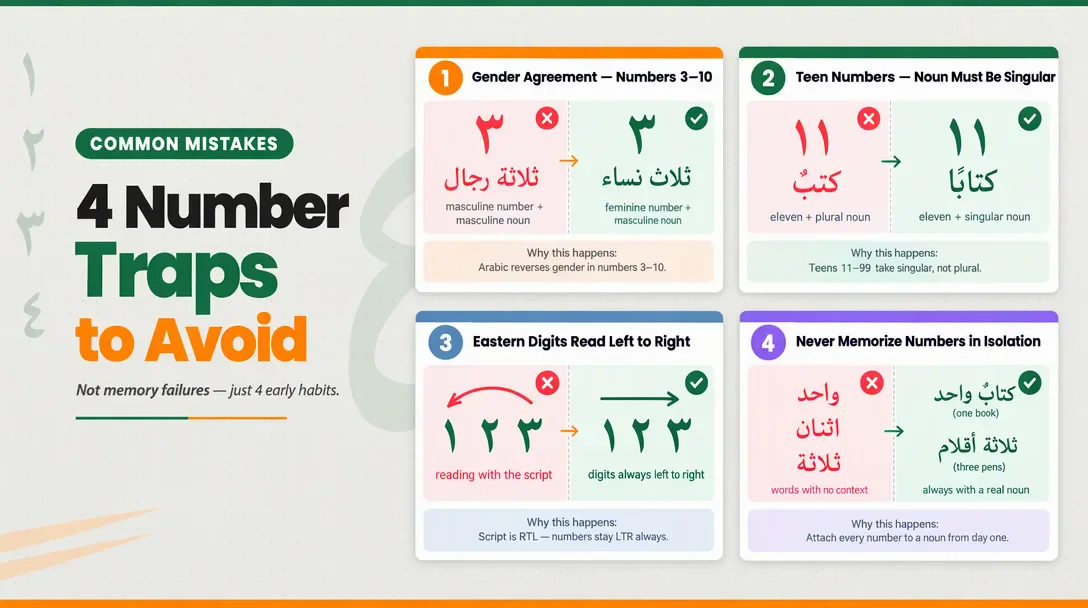
- Applying normal gender agreement to numbers 3 through 10 instead of reversing it.
- Keeping the counted noun plural after teen numbers, where Arabic requires the singular.
- Reading Eastern digits right to left along with the script instead of left to right.
- Memorizing the ten words in isolation and never attaching them to a real noun.
The fix for the gender rule is not analysis but chunking. Memorize six fixed phrases such as ثَلَاثَة كُتُب and ثَلَاث بَنَات, and the reversal starts to feel automatic without conscious calculation.
The fix for isolated memorization is equally simple. Never rehearse a number alone, always pairing it with a noun, so the agreement pattern and the vocabulary enter memory as a single unit.
Practice Plan to Memorize Arabic Numbers
A structured two-week routine moves the foundation words from recognition into recall. Each element below targets a different weakness, so running them together produces faster results than repeating any one alone.
- Write ٠ through ٩ by hand each morning, saying the word aloud with every stroke.
- Count real objects around you in Arabic, naming the noun with the number every time.
- Read prices, dates, and page numbers in Arabic script during ordinary daily activity.
- Have a partner dictate numbers while you write them in both digit systems.
- Review the ten base words with spaced repetition cards on alternating days.
- Record yourself counting from one to twenty, then compare it against a native recording.
Fifteen focused minutes daily outperforms a single long session each week. Spacing the exposure forces the brain to retrieve the word rather than simply recognize it on a page.
Expect the first ten words within a few days, the full range to one hundred within two to three weeks, and comfortable agreement with nouns after a few months of steady use.
Conclusion
Mastering arabic numbers in arabic script and speech gives a beginner something rare, which is a skill usable in the real world within days rather than months. Prices, times, and dates become readable almost immediately.
The ten base words carry the system, the gender polarity rule governs how they attach to nouns, and the two digit systems divide neatly between the eastern and western halves of the Arab world. Everything larger is built from those three pieces.
Keep the practice attached to real nouns and real contexts rather than to isolated charts. Counting objects on a table, reading a receipt, or saying the hour aloud will fix these forms more permanently than any amount of silent review.
FAQs
What Are Arabic Numbers in Arabic Words From 1 to 10?
The ten words are وَاحِد (waahid), اِثْنَان (ithnaan), ثَلَاثَة (thalaathah), أَرْبَعَة (arba'ah), خَمْسَة (khamsah), سِتَّة (sittah), سَبْعَة (sab'ah), ثَمَانِيَة (thamaaniyah), تِسْعَة (tis'ah), and عَشَرَة ('asharah), meaning one through ten.
Do All Arab Countries Use the Same Digits?
No. Egypt, the Levant, and the Gulf print Eastern digits ٠١٢٣٤٥٦٧٨٩, while Morocco, Algeria, Tunisia, Libya, and Mauritania use the Western set 0123456789. Lebanon and Sudan use both depending on context.
Why Do Numbers 3 to 10 Take the Opposite Gender?
The reversal is a feature inherited from older Semitic counting systems and has no practical logic a learner can derive. Masculine nouns pair with the ة form, feminine nouns with the bare form, and memorizing fixed phrases works better than reasoning.
How Long Does It Take to Learn Arabic 1 to 10?
Most learners recall the ten base words within three to five days of daily practice. Reaching one hundred usually takes two to three weeks, while confident noun agreement develops over several months of regular use.
Are Arabic Numerals the Same as Arabic Numbers?
No. Arabic numerals are the written digit symbols, whether Eastern or Western, while Arabic numbers are the spoken and written words such as خَمْسَة (khamsah), meaning five. A full command of the language needs both layers.
تابع جديد رحلة الكلمات
اختر إشعارات الموقع أو البريد أو الاثنين. الزائر يقدر يشترك ببريده دون تسجيل حساب.
الإبلاغ عن المقال
لو لاحظت مشكلة في المحتوى، أرسلها لفريق المراجعة. لن تظهر بياناتك لكاتب المقال أو للقراء.
تعذّر إرسال البلاغ الآن. حاول مرة أخرى لاحقًا.
سجّل الدخول لإرسال بلاغ







النقاش
التعليقات (0)
فكرة تضيفها، أو سؤال يفتح حوارًا.
الرجاء تسجيل الدخول لتتمكن من التعليق