

في هذا المقال
Key Takeaways |
| Arabic uses 28 letters written from right to left, and every one of them represents a consonant rather than a vowel. |
| Those 28 letters are drawn from only 18 base shapes, so dots above or below the shape decide which letter you are reading. |
| Each letter takes up to four positional forms, while six letters refuse to join the letter that follows them. |
| Short vowel sounds come from harakat marks placed above or below a consonant, not from separate letters. |
| Most learners recognize the full set within two weeks when they study by shape family instead of alphabetical order. |
The arabic letters of the alphabet are the entry point to reading Quranic Arabic, Modern Standard Arabic, and even Persian or Urdu. Before grammar, before vocabulary, this set of 28 characters decides how fast everything else moves.
Arabic looks intimidating at first glance because it runs right to left, joins its characters in a flowing line, and leaves most vowels invisible. None of that is as hard as it appears once the system behind the script becomes clear.
This guide lays out the full letter list with sounds and example words, the four positional forms, the shape families, the vowel marks, the two traditional orders, and the mistakes that slow beginners down.
How Many Arabic Letters of the Alphabet Exist?
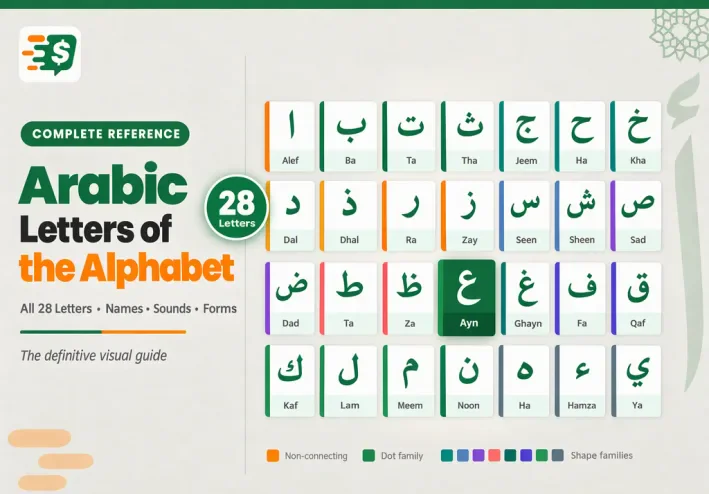
Arabic has 28 letters in the standard count used by schools, dictionaries, and Quran teaching worldwide. All 28 are consonants, and three of them double as long vowel carriers.
The count varies slightly in classical scholarship because of how hamza (ء) and the long alif (ا) are classified. Some early grammarians counted 29 by treating them as separate entities.
Counting Method | Total | What Changes |
| Standard educational count | 28 | Hamza treated as a mark, not a letter |
| Hamza counted separately | 29 | ء listed as an independent letter |
| Long alif counted separately | 29 | ا placed between و and ي as its own letter |
| Phonological count | 29 | Alif counted as a sound, hamza as its written form |
For every practical purpose, including Quran reading and language exams, the answer is 28. The dual-role letters are alif (ا), waw (و), and ya (ي), which carry the long vowels ā, ū, and ī.
Arabic also has no capital letters. A name, the first word of a sentence, and a word in the middle of a line all use exactly the same shape, which removes one layer of difficulty that English learners expect.
Complete Chart of All Letters in Arabic Alphabet
Below is the full list in traditional hijai order, which is the sequence used by modern dictionaries and classroom charts. Read each row from the Arabic character leftward into its name and sound.
Letter | Name | Transliteration | Closest English Sound | Example Word |
| ا | Alif | ā | "a" in father | أَسَد (asad), lion |
| ب | Ba | b | "b" in bat | بَاب (bab), door |
| ت | Ta | t | "t" in top | تُفَّاح (tuffah), apple |
| ث | Tha | th | "th" in think | ثَلْج (thalj), snow |
| ج | Jim | j | "j" in jam | جَمَل (jamal), camel |
| ح | Ha | ḥ | breathy h from the throat | حَلِيب (halib), milk |
| خ | Kha | kh | "ch" in Bach | خُبْز (khubz), bread |
| د | Dal | d | "d" in door | دَرْس (dars), lesson |
| ذ | Dhal | dh | "th" in this | ذَهَب (dhahab), gold |
| ر | Ra | r | rolled Spanish r | رَجُل (rajul), man |
| ز | Zay | z | "z" in zoo | زَهْرَة (zahra), flower |
| س | Sin | s | "s" in sun | سَمَك (samak), fish |
| ش | Shin | sh | "sh" in ship | شَمْس (shams), sun |
| ص | Sad | ṣ | heavy, emphatic s | صَبَاح (sabah), morning |
| ض | Dad | ḍ | heavy, emphatic d | ضَوْء (daw), light |
| ط | Ta | ṭ | heavy, emphatic t | طِفْل (tifl), child |
| ظ | Dha | ẓ | heavy, emphatic dh | ظِل (zill), shadow |
| ع | Ayn | ʿ | voiced constriction in the throat | عَيْن (ayn), eye |
| غ | Ghayn | gh | French r, gargled | غُرْفَة (ghurfa), room |
| ف | Fa | f | "f" in fan | فِيل (fil), elephant |
| ق | Qaf | q | k produced far back | قَمَر (qamar), moon |
| ك | Kaf | k | "k" in kite | كِتَاب (kitab), book |
| ل | Lam | l | "l" in lamp | لَيْل (layl), night |
| م | Mim | m | "m" in moon | مَاء (ma), water |
| ن | Nun | n | "n" in name | نَجْم (najm), star |
| ه | Ha | h | "h" in hat | هَوَاء (hawa), air |
| و | Waw | w, ū | "w" in water, "oo" in food | وَرْد (ward), roses |
| ي | Ya | y, ī | "y" in yes, "ee" in see | يَد (yad), hand |
Three letters in this chart have no workable English equivalent at all: ح (ha), ع (ayn), and ق (qaf). Hearing a native speaker produce them matters far more than any written description.
Watch the Arabic Alphabet Video Lesson
Watch the video below to review all 28 Arabic letters in their standard order. You’ll hear each letter’s name, see its written form, and learn an example word. Listen and repeat as you follow along. Some Arabic sounds have no exact English equivalent, so listening carefully and practicing with native-speaker audio can help you learn them more accurately.
Arabic Letter Sounds and English Pronunciation Guide
Sound accuracy decides whether a reader is understood. Several Arabic consonants sit in pairs where one is light and the other is heavy, and swapping them changes the word entirely.
Emphatic letters are produced with the back of the tongue raised toward the soft palate. The result is a darker, fuller sound that also colors the vowel next to it.
Light Letter | Emphatic Partner | What Changes |
| س (sin) | ص (sad) | Tongue raises, the following vowel darkens |
| د (dal) | ض (dad) | Heavier contact, deeper resonance |
| ت (ta) | ط (ta) | Fuller release, lower pitch |
| ذ (dhal) | ظ (dha) | Same tongue position, heavier body |
The contrast is not decorative. سَيْف (sayf) means sword, while صَيْف (sayf with the emphatic s) means summer, and only the heaviness of the letter separates them.
Throat letters need separate attention. ح (ha) is a tight breathy sound with no vocal cord vibration, and ع (ayn) is its voiced counterpart produced at the same point.
Learners whose first language is English often substitute a plain "h" for ح and skip ع entirely. Both habits are correctable early and extremely stubborn once they settle in.
Arabic Letters All Forms Chart for Every Position
Arabic is cursive, so a letter is drawn differently depending on whether it opens, sits inside, or closes a word. The arabic letters all forms chart below shows every shape.
| Name | Isolated | Initial | Medial | Final |
|---|---|---|---|---|
| alif | ا | ا | ـا | ـا |
| baa | ب | بـ | ـبـ | ـب |
| taa | ت | تـ | ـتـ | ـت |
| thaa | ث | ثـ | ـثـ | ـث |
| jim | ج | جـ | ـجـ | ـج |
| haa (ḥ) | ح | حـ | ـحـ | ـح |
| khaa | خ | خـ | ـخـ | ـخ |
| dal | د | د | ـد | ـد |
| dhal | ذ | ذ | ـذ | ـذ |
| raa | ر | ر | ـر | ـر |
| zay | ز | ز | ـز | ـز |
| sin | س | سـ | ـسـ | ـس |
| shin | ش | شـ | ـشـ | ـش |
| sad | ص | صـ | ـصـ | ـص |
| dad | ض | ضـ | ـضـ | ـض |
| taa (ṭ) | ط | طـ | ـطـ | ـط |
| dhaa (ẓ) | ظ | ظـ | ـظـ | ـظ |
| ayn | ع | عـ | ـعـ | ـع |
| ghayn | غ | غـ | ـغـ | ـغ |
| faa | ف | فـ | ـفـ | ـف |
| qaf | ق | قـ | ـقـ | ـق |
| kaf | ك | كـ | ـكـ | ـك |
| lam | ل | لـ | ـلـ | ـل |
| mim | م | مـ | ـمـ | ـم |
| nun | ن | نـ | ـنـ | ـن |
| haa (h) | ه | هـ | ـهـ | ـه |
| waw | و | و | ـو | ـو |
| yaa | ي | يـ | ـيـ | ـي |
Watch the Arabic Letters in All Positions
Arabic letters can take different forms depending on their position in a word. This video chart shows all 28 letters in their isolated, initial, medial, and final forms, helping learners recognize how the letters connect and change in writing. It also points out the six letters that do not connect to the letter that follows them. Watch the lesson below and practice identifying each form.
Why the Isolated Form Alone Is Not Enough
Flashcards and wall charts almost always display the isolated form, yet real text rarely shows it. A learner trained only on isolated shapes freezes the moment a connected word appears.
Write each letter in all four positions from the first day. Fifteen minutes of handwriting beats an hour of passive recognition, because the hand encodes the joining rules the eye skips.
How Letters Join Inside a Word
Joining follows one simple principle. A connecting letter links to the character before it and the character after it, forming an unbroken line along the baseline.
Take كَتَبَ (kataba), meaning "he wrote". The kaf opens in initial form, the ta sits in medial form, and the final ba closes the word on the left edge.
Six Non-Connecting Letters and Word Breaks
Six letters never join the character that follows them, even in the middle of a word. They connect only backward, to the letter on their right.
The six are ا (alif), د (dal), ذ (dhal), ر (ra), ز (zay), and و (waw). Memorize them as one unit, since they behave identically in every word.
Letter | Name | Joins Right | Joins Left |
| ا | Alif | Yes | No |
| د | Dal | Yes | No |
| ذ | Dhal | Yes | No |
| ر | Ra | Yes | No |
| ز | Zay | Yes | No |
| و | Waw | Yes | No |
These letters create visible gaps inside single words. In وَرْد (ward), meaning roses, the waw stands apart from the ra, which makes the word look like two pieces when it is one.
Far from being an obstacle, the gap is a reading aid. Once you spot a non-connector, you know the next character must appear in its initial or isolated form, which narrows your options immediately.
Read also: arabic alphabet in arabic: Full Guide to All 28 Letters and Forms
Shape Families That Group All the Arabic Letters
All the Arabic letters are built from roughly 18 base shapes. Dots, called ijam, distinguish letters that would otherwise be identical, and learning by family cuts study time sharply.
Grouping by visual similarity is the single highest-return decision a beginner can make. Instead of 28 unrelated forms, you face eight small clusters plus a handful of singles.
Base Shape | Family | Distinguishing Mark |
| Boat | ب ت ث | One dot below, two above, three above |
| Hook | ج ح خ | One dot below, no dot, one dot above |
| Back slant | د ذ | No dot, one dot above |
| Open tail | ر ز | No dot, one dot above |
| Teeth | س ش | No dots, three dots above |
| Loop | ص ض | No dot, one dot above |
| Vertical loop | ط ظ | No dot, one dot above |
| Knot | ع غ | No dot, one dot above |
Study one family per session. Write its members side by side, say each name aloud, then cover the dots and force yourself to name the shape before uncovering them again.
Dots carry full phonemic weight in Arabic, so a missing or misplaced dot is not a typo. It produces a different letter, a different root, and usually a different word.
Harakat and Diacritics That Shape Letter Sounds
Short vowels are not letters in Arabic. They are small marks, called harakat, placed above or below a consonant to tell you which vowel follows it.
Mark | Name | Sound | Placement |
| َ | Fathah | short "a" as in cat | Above the letter |
| ُ | Dammah | short "u" as in put | Above the letter |
| ِ | Kasrah | short "i" as in sit | Below the letter |
| ْ | Sukoon | no vowel follows | Above the letter |
| ّ | Shaddah | consonant doubled | Above the letter |
Three consonants with no marks are genuinely ambiguous. كتب can be read كَتَبَ (kataba), meaning "he wrote", or كُتُبٌ (kutubun), meaning "books", and only the marks or the context decide.
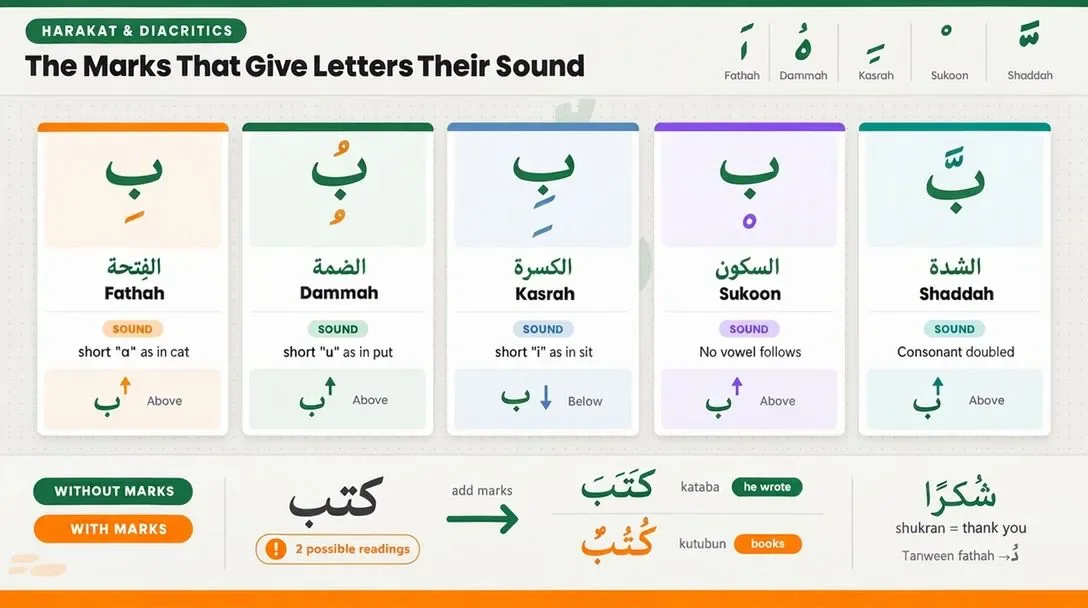
Tanween adds a final "n" sound to indefinite nouns and is written as a doubled vowel mark. شُكْرًا (shukran), meaning "thank you", ends with tanween fathah.
Everyday newspapers, novels, and websites omit these marks entirely. The Quran, children's books, and all beginner material print them in full, which is why early reading should stay inside marked texts.
Hamza Forms and Modified Letters in Arabic Script
Hamza (ء) represents the glottal stop, the catch in the throat English speakers make between the syllables of "uh-oh". Arabic writes this sound explicitly rather than leaving it implied.
Hamza may stand alone or rest on a carrier letter. The carrier is chosen by the vowels surrounding it, following orthographic rules that become automatic with reading practice.
Form | Name | Notes |
| ء | Hamza on the line | Stands alone, no carrier |
| أ | Hamza above alif | Common word-initially with fathah or dammah |
| إ | Hamza below alif | Used when the vowel is kasrah |
| ؤ | Hamza on waw | Chosen when dammah dominates |
| ئ | Hamza on ya | Chosen when kasrah dominates |
| آ | Alif maddah | Long ā following a glottal stop |
Two further characters appear constantly without being counted among the 28. ة (ta marbuta) marks feminine nouns, as in مَدْرَسَة (madrasa), meaning school, and ى (alif maqsura) closes certain words with a long ā.
Arabic also has one mandatory ligature. When lam (ل) meets alif (ا), the pair fuses into لا, as seen in لَا (la), meaning no, which is among the most frequent words in the language.
Abjadi and Hijai Orders of the Arabic Letters
Two sequences exist, and both remain in use for different purposes. Choosing the right one depends on whether you are looking a word up or reading a numbered list.
Hijai order groups characters by shape and is the arrangement used in dictionaries, phone directories, and classroom charts. Every table in this guide follows it.
Abjadi order is the older Semitic sequence shared with Hebrew and Greek, and it assigns a numeric value to each character. It survives in numbered outlines and in chronograms.
Order | Opening Sequence | Main Use |
| Hijai | ا ب ت ث ج ح خ | Dictionaries, indexes, teaching charts |
| Abjadi | ا ب ج د ه و ز | Numbering, numerology, classical texts |
The letters of the alphabet in Arabic take values from 1 to 1000 under the abjadi system. Alif equals 1, ya equals 10, qaf equals 100, and ghayn equals 1000.
The name abjadiyya (أبجدية) itself comes from the first four characters of this older order: alif, ba, jim, dal. English "alphabet" was formed the same way from alpha and beta.
Eastern Arabic Numerals Used Alongside the Letters
Numerals deserve a place in any complete reference, because printed Arabic mixes two digit systems depending on the country. Both descend from the same Indian origin.
Western | ٠ | ١ | ٢ | ٣ | ٤ | ٥ | ٦ | ٧ | ٨ | ٩ |
| Value | 0 | 1 | 2 | 3 | 4 | 5 | 6 | 7 | 8 | 9 |
Egypt, Saudi Arabia, Sudan, and Iran use the Eastern forms shown above. Morocco, Algeria, and Tunisia typically print the Western digits familiar to English readers.
One detail surprises newcomers. Numbers run left to right even inside right-to-left text, so the highest place value always sits on the left exactly as it does in English.
Practical Steps to Memorize All the Arabic Alphabet
Memorizing all the Arabic alphabet is a two-week project for most adults who study with focus. The method matters more than the hours invested.
- Learn one shape family per session rather than following alphabetical order.
- Write every letter in all four positional forms before moving to the next family.
- Listen to a native recording of each letter name and sound, then imitate it aloud.
- Start reading real words as soon as you know five or six characters.
- Review yesterday's family for five minutes before starting anything new.
- Drill confusable pairs separately, especially ب ت ث and ج ح خ.
Handwriting deserves special emphasis. Producing all letters in Arabic by hand activates motor memory that passive recognition never touches, which is why ten daily minutes with pen and paper outperform an hour of scrolling.
Reading aloud is the second pillar. Silent reading hides pronunciation errors, while reading aloud exposes them immediately and lets a teacher or recording correct them on the spot.
Daily Practice Schedule for Week One
A compressed schedule keeps momentum without causing fatigue. Twenty focused minutes per day is enough to cover the full set in seven sessions.
Day | Focus | Task |
| 1 | ا ب ت ث | Write all four forms, read 5 example words |
| 2 | ج ح خ د ذ | Review day 1, add new family |
| 3 | ر ز س ش | Drill the non-connectors ر and ز |
| 4 | ص ض ط ظ | Contrast each with its light partner |
| 5 | ع غ ف ق | Record yourself on ع and ق |
| 6 | ك ل م ن | Practice the lam-alif ligature لا |
| 7 | ه و ي | Full review, read a short marked passage |
Reading Your First Words With Confidence
Move to words the moment you control a handful of characters. Short three-letter words carry fewer unknowns and give the fastest sense of progress.
Begin with fully marked text so every vowel is visible. بَيْت (bayt) meaning house, قَلَم (qalam) meaning pen, and وَلَد (walad) meaning boy are reliable starting points.
Common Mistakes Beginners Make With Arabic Letters
Certain errors repeat across almost every beginner. Naming them early prevents months of correction later, since a habit formed in week one takes far longer to unlearn.
- Memorizing in alphabetical order instead of by shape family, which triples the apparent workload.
- Studying only isolated forms, which leaves the reader stranded the first time real connected text appears.
- Treating the emphatic letters as louder versions of their light partners rather than separate sounds.
- Skipping ع and ح because they feel awkward, which embeds a mispronunciation that later resists correction.
- Jumping to unmarked text too early, before the eye can supply missing short vowels from context.
- Ignoring dot count under speed, which turns ب, ت, and ث into one blurred shape.
Reading unmarked text fluently is a later milestone, not an early one. It depends on vocabulary and grammar, so it typically arrives six to twelve months after letter recognition is solid.
Patience pays here. Recognition of the arabic letters of the alphabet comes in days, accurate pronunciation in weeks, and fluent unmarked reading in months, and each stage rests on the one below it.
Conclusion
The arabic letters of the alphabet form a compact, logical system: 28 consonants, 18 base shapes, four positional forms, six non-connectors, and a small set of marks that supply the vowels.
Every feature that looks difficult at first turns out to reduce effort once understood. Dots cut the number of shapes to learn, gaps from non-connectors help segment words, and the absence of capitals removes an entire category of rules.
Work through the charts in this guide one family at a time, write by hand every day, and read aloud from marked text. Within two weeks the script stops looking like decoration and starts reading like language.
FAQs
How Many Letters Are in the Arabic Alphabet?
Arabic has 28 letters, all of them consonants. Three of those letters, alif (ا), waw (و), and ya (ي), also carry the long vowels ā, ū, and ī. Short vowels come from separate marks called harakat.
What Is the Arabic Alphabet Called in Arabic?
It is called الأبجدية العربية (al-abjadiyya al-arabiyya), meaning the Arabic abjad. An abjad is a writing system that records consonants, leaving short vowels to optional diacritical marks rather than full letters.
Is Arabic Written Right to Left?
Yes, Arabic text runs right to left, and the script is fully cursive so letters join within a word. Numerals are the exception and run left to right, even in the middle of Arabic text.
How Long Does It Take to Learn All the Arabic Letters?
Most learners recognize all 28 characters within seven to fourteen days at twenty focused minutes daily. Reading simple marked words follows in the first month, while fluent unmarked reading takes six to twelve months.
Which Arabic Letters Do Not Connect to the Next Letter?
Six letters never join the character after them: ا (alif), د (dal), ذ (dhal), ر (ra), ز (zay), and و (waw). They connect only to the letter on their right, creating visible gaps inside words.
Does Arabic Have Capital Letters?
No, Arabic has no upper and lower case distinction. Letter shape changes according to position in the word, not according to sentence start or proper noun status, which removes a rule English learners expect.
تابع جديد رحلة الكلمات
اختر إشعارات الموقع أو البريد أو الاثنين. الزائر يقدر يشترك ببريده دون تسجيل حساب.
الإبلاغ عن المقال
لو لاحظت مشكلة في المحتوى، أرسلها لفريق المراجعة. لن تظهر بياناتك لكاتب المقال أو للقراء.
تعذّر إرسال البلاغ الآن. حاول مرة أخرى لاحقًا.
سجّل الدخول لإرسال بلاغ






النقاش
التعليقات (0)
فكرة تضيفها، أو سؤال يفتح حوارًا.
الرجاء تسجيل الدخول لتتمكن من التعليق