

في هذا المقال
Key Takeaways |
Arabic has 28 consonant letters built on roughly 18 base shapes, with dots alone distinguishing many of them from each other. |
Each letter takes up to four positional forms, but six letters never connect forward and cut a word into visual blocks. |
Short vowels are not letters. They are marks placed above or below consonants and are usually omitted in everyday text. |
Most learners recognize all 28 letters within two weeks when they study by shape family instead of alphabetical order. |
Anyone who opens a page of Arabic for the first time faces a single practical question before anything else. Knowing what the arabic alphabet in arabic script actually is decides how quickly reading becomes possible rather than guesswork.
Arabic is written right to left in a fully cursive hand, which means letters inside one word join together and change shape as they join. That behavior is the single largest difference between this script and the Latin alphabet.
This article covers the names of the letters, the complete sound inventory, every positional form, the dot system, vowel marks, numerals, and the classical orderings scholars used.
What Is the Arabic Alphabet in Arabic Script?
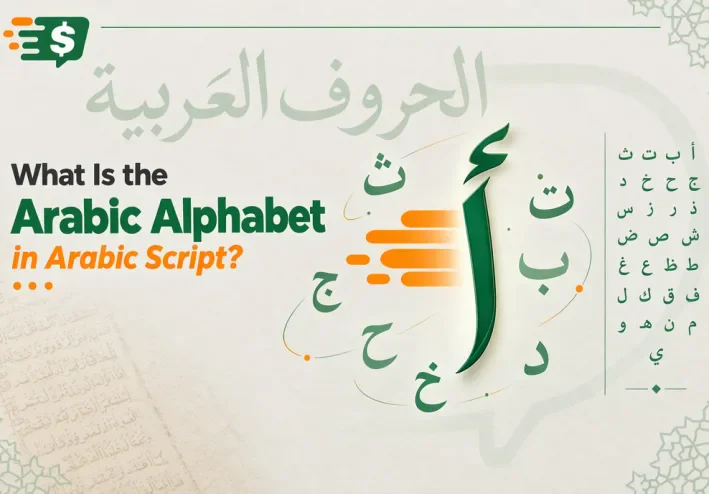
The arabic alphabet in arabic script is a set of 28 consonant letters written cursively from right to left, drawn from about 18 base shapes that dots separate into distinct letters.
In Arabic the system is called
الأَبْجَدِيَّة العَرَبِيَّة
(al-abjadiyya al-ʿarabiyya)
"the Arabic alphabet"
Native speakers more often say
الحُرُوف
(al-huruf)
"the letters"
Classification matters here. Arabic is an abjad, not a full alphabet, because the written letters carry consonants while short vowels sit outside the letter inventory as optional marks.
That single design choice explains most of what beginners find strange: missing vowels, identical-looking words, and heavy reliance on context when reading an unvocalized newspaper line.
Abjadiyya Arabiyya and Why Arabic Is Called an Abjad
The word abjad comes from the first four letters of the old Semitic sequence, alif, ba, jim, dal, exactly as "alphabet" comes from the Greek alpha and beta.
A full alphabet writes consonants and vowels with equal status. An abjad writes consonants as letters and treats short vowels as diacritics that a skilled reader supplies mentally from grammar and context.
Feature | Full Alphabet | Arabic Abjad |
Short vowels | Written as letters | Written as optional marks |
Direction | Usually left to right | Right to left |
Letter joining | Optional, print is separate | Mandatory and cursive |
Letter count | Fixed shapes | 28 letters from 18 base shapes |
The same script serves Persian, Urdu, Pashto, Kurdish, Uyghur, and Malay in its Jawi form. Each of those languages adds letters for sounds Arabic itself does not contain.
Complete Chart of Arabic Letters in Arabic Order
The standard modern sequence is the abtathi order, arranged by shape similarity. Below are all 28 arabic letters in arabic order with their names, closest sound, and a sample word.
Letter | Name | Closest Sound | Example Word |
ا | alif | long "aa" | أَب (ab) father |
ب | baa | b | بَاب (bab) door |
ت | taa | t | تُفَّاح (tuffah) apple |
ث | thaa | th in "think" | ثَلْج (thalj) snow |
ج | jim | j | جَمَل (jamal) camel |
ح | haa | breathy h | حَلِيب (halib) milk |
خ | khaa | ch in "loch" | خُبْز (khubz) bread |
د | dal | d | دَرْس (dars) lesson |
ذ | dhal | th in "this" | ذَهَب (dhahab) gold |
ر | raa | tapped r | رَجُل (rajul) man |
ز | zay | z | زَهْرَة (zahra) flower |
س | sin | s | سَمَاء (sama) sky |
ش | shin | sh | شَمْس (shams) sun |
ص | sad | emphatic s | صَبَاح (sabah) morning |
ض | dad | emphatic d | ضَوْء (daw) light |
ط | taa | emphatic t | طِفْل (tifl) child |
ظ | dhaa | emphatic th | ظِل (zill) shade |
ع | ayn | deep throat sound | عَيْن (ayn) eye |
غ | ghayn | gargled r | غُرْفَة (ghurfa) room |
ف | faa | f | فِيل (fil) elephant |
ق | qaf | k from the throat | قَمَر (qamar) moon |
ك | kaf | k | كِتَاب (kitab) book |
ل | lam | l | لَيْل (layl) night |
م | mim | m | مَاء (ma) water |
ن | nun | n | نَجْم (najm) star |
ه | haa | h | هِلَال (hilal) crescent |
و | waw | w or long "oo" | وَرْد (ward) roses |
ي | yaa | y or long "ee" | يَد (yad) hand |
Five sounds have no English equivalent at all: ح, ع, غ, ق, and the emphatic group ص ض ط ظ. These need imitation of a native speaker rather than a written description.
Watch the Arabic Alphabet Video Lesson
Watch the video below to review all 28 Arabic letters in their standard order. You’ll hear each letter’s name, see its written form, and learn an example word. Listen and repeat as you follow along. Some Arabic sounds have no exact English equivalent, so listening carefully and practicing with native-speaker audio can help you learn them more accurately.
Emphatic Letters and the Tongue Position Behind Them
Emphatic letters are produced by raising the back of the tongue toward the soft palate while the front makes the ordinary consonant. The result sounds heavier and darker to an English ear.
Compare سَيْف (sayf) "sword" with صَيْف (sayf) "summer". The only difference is س versus ص, yet the two words are unrelated. Mishearing that contrast changes meaning completely.
Letters With Regional Pronunciation Differences
Several letters vary by country without being wrong. The letter ج is pronounced as "j" across most of the Arab world, as a soft "zh" in the Levant and Morocco, and as a hard "g" in Egypt.
The letter ق also shifts, surfacing as a glottal stop in many urban dialects and as a hard "g" across the Gulf and parts of Upper Egypt. Formal recitation keeps the classical deep "q".
Arabic Letters All Forms Chart for Every Position
Arabic is cursive, so a letter is drawn differently depending on whether it opens, sits inside, or closes a word. The arabic letters all forms chart below shows every shape.
Name | Isolated | Initial | Medial | Final |
alif | ا | ا | ـا | ـا |
baa | ب | بـ | ـبـ | ـب |
taa | ت | تـ | ـتـ | ـت |
thaa | ث | ثـ | ـثـ | ـث |
jim | ج | جـ | ـجـ | ـج |
haa | ح | حـ | ـحـ | ـح |
khaa | خ | خـ | ـخـ | ـخ |
dal | د | د | ـد | ـد |
dhal | ذ | ذ | ـذ | ـذ |
raa | ر | ر | ـر | ـر |
zay | ز | ز | ـز | ـز |
sin | س | سـ | ـسـ | ـس |
shin | ش | شـ | ـشـ | ـش |
sad | ص | صـ | ـصـ | ـص |
dad | ض | ضـ | ـضـ | ـض |
taa | ط | طـ | ـطـ | ـط |
dhaa | ظ | ظـ | ـظـ | ـظ |
ayn | ع | عـ | ـعـ | ـع |
ghayn | غ | غـ | ـغـ | ـغ |
faa | ف | فـ | ـفـ | ـف |
qaf | ق | قـ | ـقـ | ـق |
kaf | ك | كـ | ـكـ | ـك |
lam | ل | لـ | ـلـ | ـل |
mim | م | مـ | ـمـ | ـم |
nun | ن | نـ | ـنـ | ـن |
haa | ه | هـ | ـهـ | ـه |
waw | و | و | ـو | ـو |
yaa | ي | يـ | ـيـ | ـي |
Notice how little actually changes for most letters. The initial and medial shapes are usually the same body with a connecting stroke added on the right side.
Only ه shows dramatic variation across its four positions, which is why beginners often fail to recognize هـ and ـهـ as the same letter they learned in isolation.
Watch the Arabic Letters in All Positions
Arabic letters can take different forms depending on their position in a word. This video chart shows all 28 letters in their isolated, initial, medial, and final forms, helping learners recognize how the letters connect and change in writing. It also points out the six letters that do not connect to the letter that follows them. Watch the lesson below and practice identifying each form.
Six Non-Connecting Letters That Break a Word
Six letters attach to whatever precedes them but refuse to attach to whatever follows. They create a visible gap in the middle of a word, and that gap is not a word boundary.
The six non-connecting letters are:
- ا alif.
- د dal.
- ذ dhal.
- ر raa.
- ز zay.
- و waw.
Take the word بَاب (bab) "door". The first ب joins the alif, the alif then refuses to join forward, so the final ب appears in its isolated shape rather than its final shape.
This behavior is genuinely useful once understood. Spotting a non-connector tells you instantly that the next letter must appear in its initial or isolated form, which narrows your reading guess.
Shape Families That Group Arabic Letters by Dots
Studying the sequence alif, baa, taa in order is the slowest available method. Grouping by skeleton is faster because the eye learns one shape and then learns the dots that ride on it.
Base Shape | Letters | Distinguishing Dots |
Small hook with tail | ب ت ث | 1 below, 2 above, 3 above |
Curved bowl | ج ح خ | 1 inside, none, 1 above |
Backward slant | د ذ | none, 1 above |
Descending tail | ر ز | none, 1 above |
Three teeth | س ش | none, 3 above |
Looped body | ص ض | none, 1 above |
Vertical loop | ط ظ | none, 1 above |
Knot shape | ع غ | none, 1 above |
Eight families cover twenty letters. The remaining eight letters have shapes distinct enough that no confusion pair exists, so they can be learned individually without extra drilling.
Dots were not part of the original script. Early Qur'anic manuscripts were written without them, and readers relied on context until Nasr ibn Asim and Yahya ibn Yamur formalized the dotting system.
Short Vowels and Tashkeel Marks Above Each Letter
Short vowels are written as
تَشْكِيل
(tashkeel)
"vocalization marks"
These marks sit above or below a consonant and are omitted in newspapers, signage, and ordinary books. They are fully written in the Qur'an, children's books, poetry, and learning material.
Mark | Name | Position | Sound |
بَ | fatha | above | short "a" as in cat |
بُ | damma | above | short "u" as in put |
بِ | kasra | below | short "i" as in sit |
بْ | sukun | above | no vowel follows |
بّ | shadda | above | consonant is doubled |
بً بٌ بٍ | tanween | above or below | adds a final "n" sound |
The stakes are high because vowels carry meaning. The three consonants ك ت ب produce كَتَبَ (kataba) "he wrote" and كُتُب (kutub) "books" depending entirely on which marks are applied.
Long vowels are different. They are written with the actual letters ا, و, and ي, which is why those three appear both as consonants and as vowel carriers depending on the word.
Hamza, Ta Marbuta, and Alif Maqsura Explained
Three symbols confuse learners because they look like letters, behave like letters, and yet are not counted among the 28.
Hamza and Its Five Written Seats
Hamza represents the glottal stop, the catch in the throat between the two halves of "uh-oh". English makes this sound constantly without writing it; Arabic writes it explicitly.
Hamza appears alone as ء, or carried on a seat: أ and إ on alif, ؤ on waw, ئ on yaa. The surrounding vowels decide which seat is correct, following fixed spelling rules.
Ta Marbuta and Alif Maqsura at Word Endings
Ta marbuta ة is a closed form of ت that marks most feminine nouns. It is pronounced as a soft "h" when the word is paused on, and as "t" when the sentence continues.
Alif maqsura ى is a dotless yaa that carries the long "aa" sound at the end of certain words, as in مُوسَى (Musa) "Moses". It never takes the two dots of a true yaa.
Eastern Arabic Numerals Used Alongside the Letters
Two numeral systems are in circulation. Egypt, Saudi Arabia, the Gulf, and Iran use the Eastern forms, while Morocco, Algeria, and Tunisia generally use the Western digits familiar to English readers.
٠ | ١ | ٢ | ٣ | ٤ | ٥ | ٦ | ٧ | ٨ | ٩ |
0 | 1 | 2 | 3 | 4 | 5 | 6 | 7 | 8 | 9 |
One detail surprises almost everyone. Numbers run left to right even inside right-to-left text, so the year ١٩٨٥ is read exactly as 1985 rather than reversed.
Watch ٥ and ٦ carefully. The Eastern five resembles a Western zero and the Eastern six resembles a Western seven, a pair of traps that cause real errors with prices and dates.
How Arabic Written in Arabic Differs From Transliteration
Transliteration is a scaffold, not a destination. Reading arabic written in arabic from the start prevents the habit of mentally translating shapes into Latin letters before sounding them out.
Romanization systems also disagree with one another. The same word appears as Muhammad, Mohammed, or Muḥammad depending on the scheme, while the Arabic spelling محمد never changes.
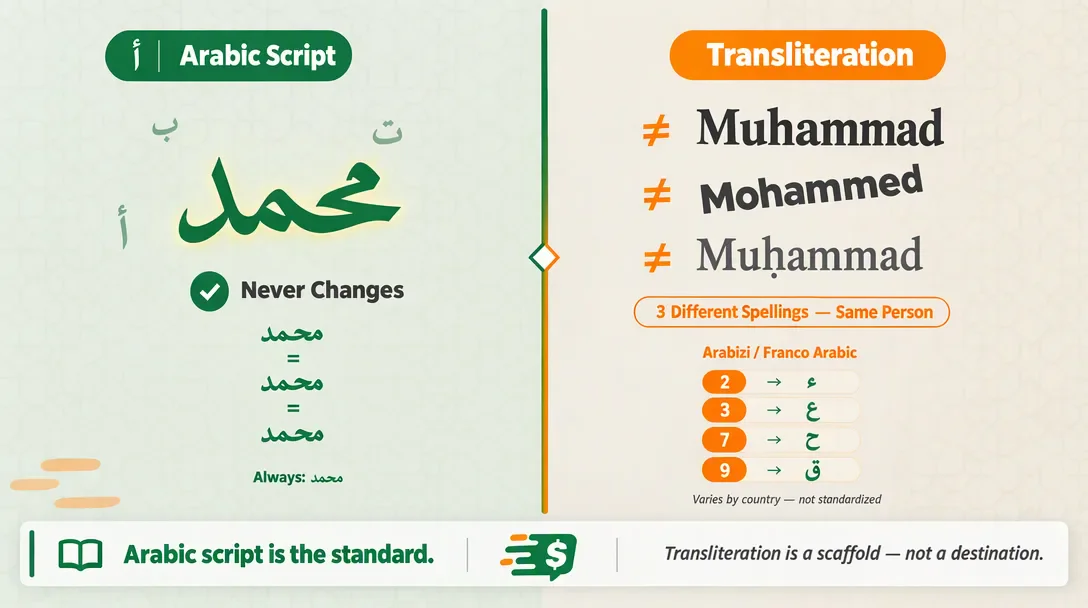
Informal chat romanization adds another layer. Online writers substituted digits for sounds the English keyboard lacks, producing the system often called Franco Arabic or Arabizi.
Digit | Arabic Letter | Reason for the Choice |
2 | ء | shape resembles the hamza |
3 | ع | mirror image of ayn |
5 | خ | shorthand for khaa |
7 | ح | shape resembles haa |
9 | ق | shape resembles qaf |
No academy or language council ever adopted this system. It varies between countries, encodes dialect rather than standard Arabic, and should be treated as slang rather than a writing standard.
Three Classical Orderings of Arabic Letters in Arabic
Modern dictionaries use one sequence, but Arab grammarians developed three, each built for a different purpose. Knowing all three explains inconsistencies readers meet in older books.
Order | Principle | Primary Use |
Abjadi | Historical Semitic sequence | Numbering and chapter labels |
Abtathi | Visual shape similarity | Dictionaries, indexes, lists |
Phonetic | Articulation point in the mouth | Recitation study and early lexicons |
The abjadi order is memorized through eight nonsense words:
أبجد، هوز، حطي، كلمن، سعفص، قرشت، ثخذ، ضظغ
(abjad, hawwaz, hutti, kalaman, saʿfas, qarashat, thakhadh, dazagh)
"the traditional mnemonic sequence of the letters"
That order also powers
حِسَاب الجُمَّل
(hisab al-jummal)
"letter numerology"
In that system each letter carries a numeric value from 1 to 1000, which scholars used to encode dates inside verses of poetry. The phonetic order traces to Al-Khalil ibn Ahmad al-Farahidi and begins at the throat with ع.
Common Mistakes When Learning Arabic in Arabic Script
Most stalled progress comes from a small set of predictable habits rather than from the difficulty of the script itself. Each one has a direct fix.
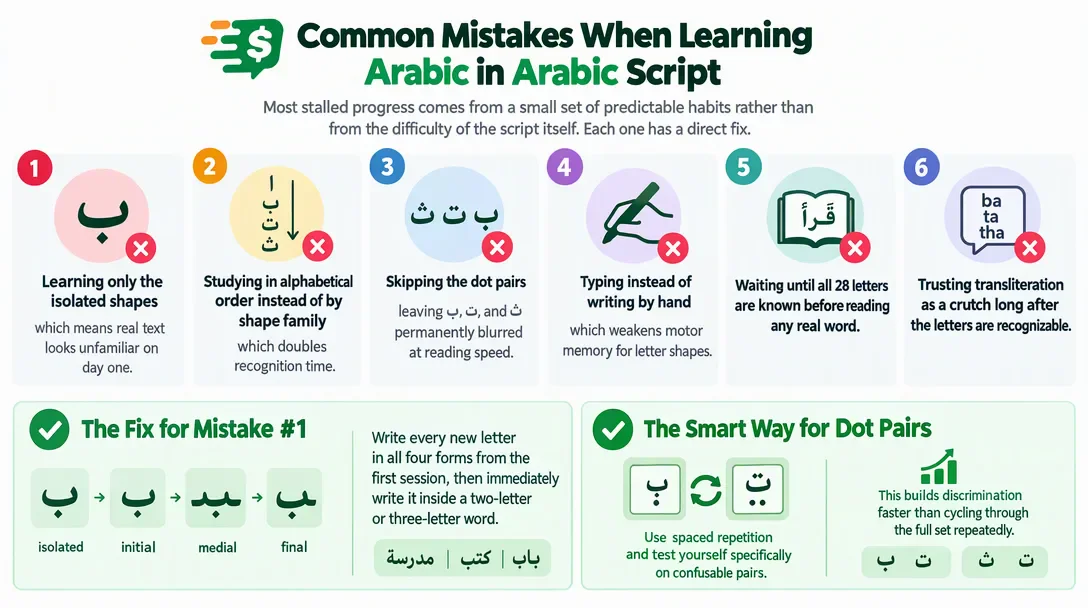
- Learning only the isolated shapes, which means real text looks unfamiliar on day one.
- Studying in alphabetical order instead of by shape family, which doubles recognition time.
- Skipping the dot pairs, leaving ب, ت, and ث permanently blurred at reading speed.
- Typing instead of writing by hand, which weakens motor memory for letter shapes.
- Waiting until all 28 letters are known before reading any real word.
- Trusting transliteration as a crutch long after the letters are recognizable.
The correction for the first mistake is simple. Write every new letter in all four forms from the first session, then immediately write it inside a two-letter or three-letter word.
Spaced repetition handles the dot pairs better than massed review. Testing yourself specifically on confusable pairs builds discrimination faster than cycling through the full set repeatedly.
How Long Learning All Forms of Arabic Letters Takes
Recognition and fluency are separate milestones with very different timelines. Treating them as one goal is what makes learners feel they are failing when they are actually on schedule.
Stage | Typical Time | What You Can Do |
| Letter recognition | 7 to 14 days | Name every isolated letter on sight |
| All forms of arabic letters | 3 to 5 weeks | Read joined words with vowel marks |
| Vocalized reading | 2 to 3 months | Read Qur'anic or children's text aloud |
| Unvocalized reading | 6 to 12 months | Read newspapers without diacritics |
The final stage depends on vocabulary and grammar, not on the script. Supplying missing short vowels requires knowing which word pattern is expected, which only exposure can build.
Twenty focused minutes daily outperforms a three-hour weekend session. Letter recognition is a perceptual skill, and perceptual skills consolidate through frequency of exposure rather than total hours.
Conclusion
The arabic alphabet in arabic script rewards a structured approach more than raw study time. Twenty-eight letters, eighteen base shapes, and a dot system account for nearly everything a reader must recognize.
Four positional forms, six non-connecting letters, and a set of optional vowel marks complete the picture. None of these elements is complex alone, and together they form a system that is consistent and highly phonetic.
Start with shape families, write by hand daily, and read real words as soon as five or six letters are secure. Within two weeks the script stops looking like decoration and starts behaving like text.
FAQs
What Is the Arabic Alphabet Called in Arabic?
It is called al-abjadiyya al-ʿarabiyya, written الأبجدية العربية. Everyday speakers usually say al-huruf, meaning "the letters". The term abjad comes from the first four letters of the old Semitic order: alif, ba, jim, dal.
How Many Letters Are in the Arabic Alphabet?
Arabic has 28 consonant letters. Some classical grammarians counted 29 by treating hamza as separate from alif. These 28 letters are drawn from roughly 18 base shapes, with dots creating the remaining distinctions.
Why Do Arabic Letters Change Shape in a Word?
Arabic is a cursive script, so letters connect to their neighbors. Each letter has up to four forms: isolated, initial, medial, and final. Six letters never connect forward, creating visible gaps inside words.
Does Arabic Have Vowels?
Arabic has three long vowels written as the letters alif, waw, and yaa. Short vowels are diacritic marks, fatha, damma, and kasra, placed above or below consonants. Everyday text usually omits them entirely.
Is Arabic Written Right to Left?
Yes, Arabic letters and words run right to left, and lines are read top to bottom. Numbers are the exception, since digits are written and read left to right even within Arabic text.
What Is the Fastest Way to Learn Arabic Letters?
Group letters by shape family rather than alphabetical order, practice all four positional forms from day one, write by hand for ten minutes daily, and begin reading real words once five letters are secure.
تابع جديد رحلة الكلمات
اختر إشعارات الموقع أو البريد أو الاثنين. الزائر يقدر يشترك ببريده دون تسجيل حساب.
الإبلاغ عن المقال
لو لاحظت مشكلة في المحتوى، أرسلها لفريق المراجعة. لن تظهر بياناتك لكاتب المقال أو للقراء.
تعذّر إرسال البلاغ الآن. حاول مرة أخرى لاحقًا.
سجّل الدخول لإرسال بلاغ









النقاش
التعليقات (0)
فكرة تضيفها، أو سؤال يفتح حوارًا.
الرجاء تسجيل الدخول لتتمكن من التعليق