Irregular Verbs Made Easy: Understanding Vowel Shifters and Shape-Shifters
Irregular Verbs Made Easy: Understanding Vowel Shifters and Shape-Shifters
?What Are Irregular Verbs
Irregular verbs are verbs that change their form when used the past tense and past participle. These verbs do not follow the normal grammar rules, which means they must be learned through practice and repetition
:For example
- Go → Went → Gone
- Eat → Ate → Eaten
- Write → Wrote → Written
Because irregular verbs are commonly used in everyday English, mastering them is essential for language fluency
The Vowel Shifters Pattern
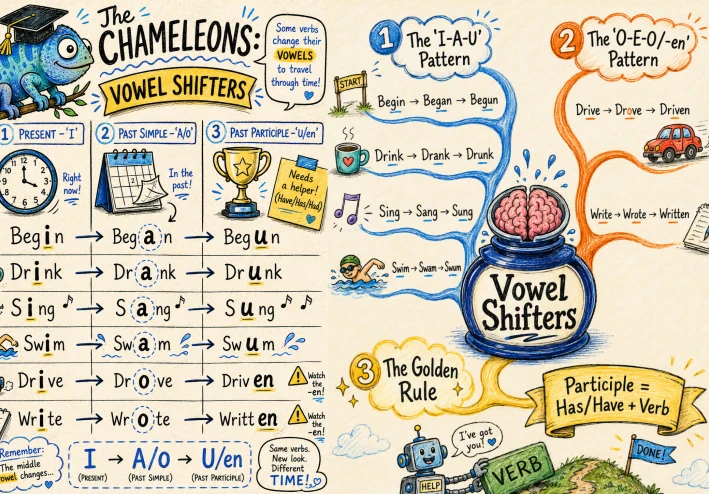
One of the easiest ways to learn irregular verbs is by grouping them into patterns. The “Vowel Shifters” are verbs that change their middle vowel sound as they move through different tenses
:Examples include
- Begin → Began → Begun
- Drink → Drank → Drunk
- Sing → Sang → Sung
- Swim → Swam → Swum
In these examples, the vowel changes from “I” in the present tense to “A” in the past tense and then to “U” in the past participle. Recognizing this pattern makes memorization much easier
The O-E-O and -en Pattern
Another common group of irregular verbs follows the O-E-O pattern and often ends with “-en” in the past participle form
Examples include:
- Drive → Drove → Driven
- Write → Wrote → Written
These verbs are frequently used in daily conversations and written English. Learning them as a group can help students remember them more quickly and accurately
The Shape-Shifters: Total Transformations
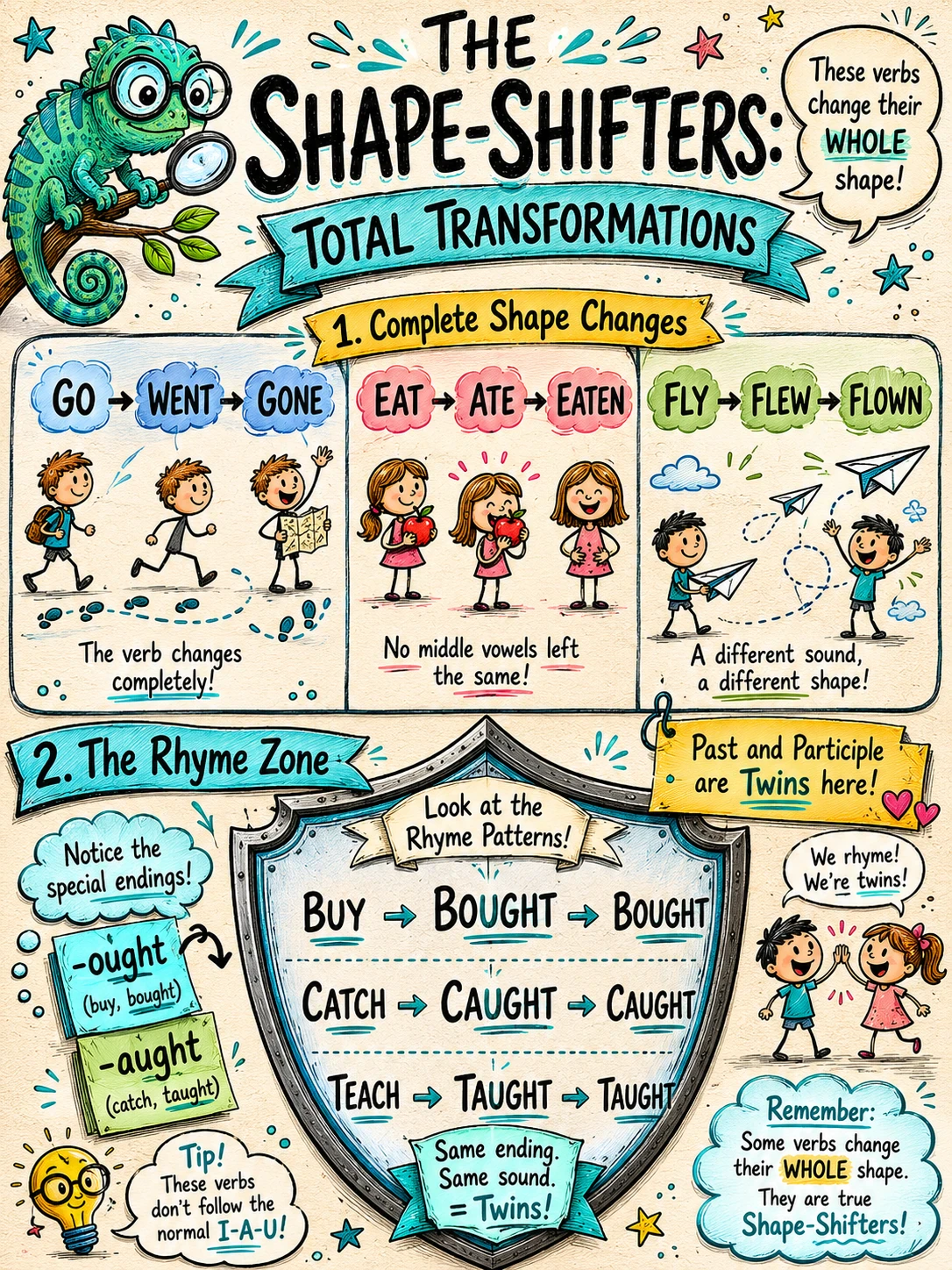
Some irregular verbs change completely and do not follow a predictable pattern. These verbs are often called “Shape-Shifters” because their forms transform dramatically
:Examples includ
- Go → Went → Gone
- Eat → Ate → Eaten
- Fly → Flew → Flown
Since these verbs do not follow a simple rule, learners should practice them regularly through reading, writing, and speaking activities
The Rhyme Zone
Certain irregular verbs share similar sounds in their past and past participle forms. This category is often called the
Rhyme Zone
:Examples include
- Buy → Bought → Bought
- Catch → Caught → Caught
- Teach → Taught → Taught
The similar endings make these verbs easier to remember. Paying attention to pronunciation can help students recognize and memorize these patterns more efficiently
Why Learning Verb Patterns Matters
Studying irregular verbs through patterns is much more effective than memorizing long lists. When learners identify similarities between verbs, they can remember them faster and use them more confidently
Visual learning tools such as mind maps, sketchnotes, and educational infographics are especially useful because they combine words, colors, and illustrations to improve memory retention
Tips for Mastering Irregular Verbs
:Here are some practical tips for learning irregular verbs
- Learn verbs in groups rather than individually
- Practice using them in complete sentences
- Create flashcards with all three verb forms
- Use visual charts and infographics
- Review frequently to strengthen long-term memory
Consistent practice is the key to mastering irregular verbs and improving overall English proficiency
Conclusion
Irregular verbs are an important part of English grammar, but they do not have to be difficult. By learning patterns such as Vowel Shifters, Shape-Shifters, and Rhyme Zone verbs, students can build their confidence and improve their language skills more quickly. With regular practice and the help of visual learning resources, mastering irregular verbs becomes an enjoyable and rewarding experience