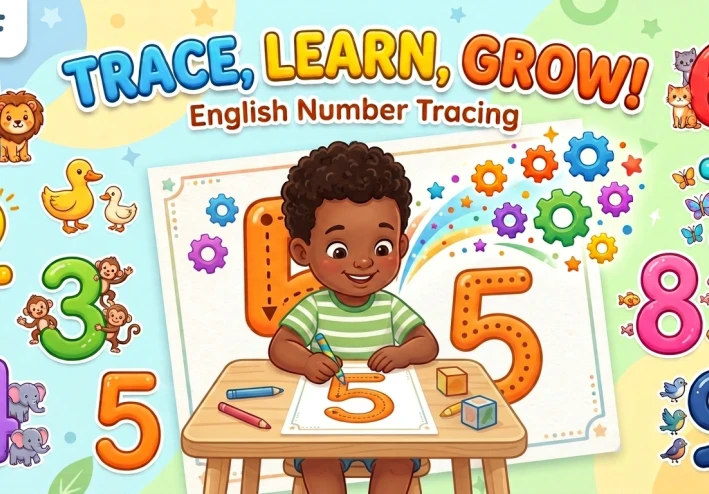
Why Number Tracing is Essential for Early Childhood Development
Why Number Tracing is Essential for Early Childhood Development
In the early stages of education, parents and educators are constantly looking for effective ways to introduce young learners to math and writing. One of the most powerful, tried-and-tested methods is number tracing.
While it might look like a simple, repetitive activity of connecting dots, number tracing for kids is actually a critical stepping stone. It bridges the gap between physical coordination, early literacy, and foundational mathematical thinking.
In this article, we’ll explore why practicing english numbers tracing is a game-changer for preschoolers and how it sets them up for long-term academic success.
1. Development of Fine Motor Skills & Pencil Control
Before a child can write a full sentence or solve a math equation, they must develop the small muscles in their hands, fingers, and wrists. This is known as fine motor skills development.
Grip Strength: Holding a crayon, marker, or pencil correctly requires muscle memory.
Precision: Following the guided dotted lines teaches children how to control their hand movements, preventing hand fatigue when they transition to independent writing.
Spatial Awareness: Tracing helps kids understand boundaries, teaches them where a stroke starts, and where it ends.
2. Boosting Number Recognition and Math Readiness
Can a child count to 10? Yes. But do they know what the number "7" actually looks like?
Counting out loud is an auditory skill, but number recognition is a visual and cognitive one. Number tracing worksheets provide a multi-sensory learning approach:
1. The Visual: They see the shape of the number.
2. The Tactile: They physically feel the movement of forming that number.
3. The Cognitive: They connect the symbol (e.g., "3") to its quantity (e.g., three apples drawn next to it).
This multi-sensory connection is crucial for preschool math skills, laying the groundwork for future concepts like addition, subtraction, and mental math.
3. Correcting Number Reversals (Building Muscle Memory)
It is incredibly common for young learners in kindergarten to write numbers backward—especially numbers like 2, 5, 3, and 7.
By utilizing guided tracing numbers 1-10 or 1-20 sheets, children practice the exact strokes required for each digit. Repeating this correct pathway forms strong neurological connections, minimizing reversals and helping them write confidently on blank paper.
4. Building Academic Confidence and Focus
Sitting down to write on a blank page can be intimidating for a 3 or 4-year-old. It often triggers frustration.
Why tracing works: Tracing acts as an "insurance policy" for the child. Because the path is already drawn for them, the fear of making mistakes is dramatically reduced.
Achieving success page after page builds their learning confidence. Furthermore, staying along the lines requires steady concentration, which naturally expands a preschooler's attention span.
Summary: A Quick Look at the Benefits
1. Fine Motor Skills: It builds muscle memory, grip strength, and pencil control, which leads to better handwriting and less hand fatigue.
2. Hand-Eye Coordination: Following dotted lines teaches kids precision and spatial awareness.
3. Math Readiness: It connects the visual symbol of the number to its actual quantity, building a solid foundation for school-level Mathematics.
Final Thoughts for Parents and Educators
If you want to prepare your child for school, don't rush straight into abstract math. Start with printable number tracing worksheets or interactive tracing apps. Make it fun by using sand trays, finger paints, or colorful markers.
By turning number tracing into an engaging daily routine, you aren’t just teaching them how to write English numbers—you are building the physical and mental infrastructure for their entire educational journey_
https://drive.google.com/file/d/1KhbxDAU1hs_h7oiPWEMMA8BfpIo_fdiv/view?usp=drivesdk