Tag question in English
TAG QUESTIONS
A Complete Grammar Lesson
English Grammar Series
1. What Is a Tag Question?
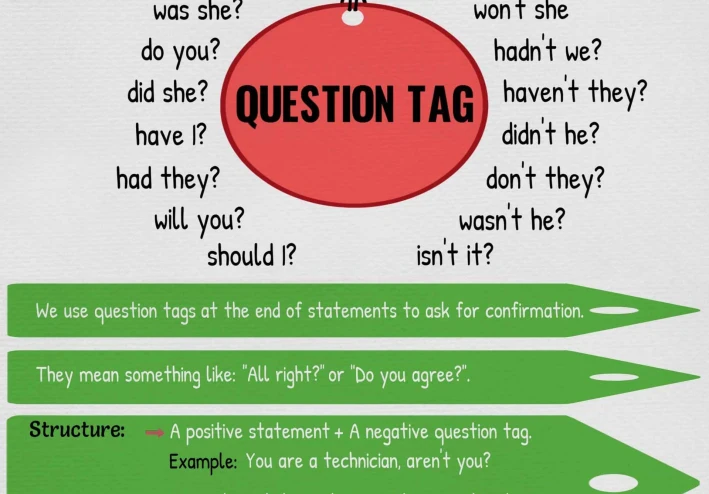
A tag question is a short question added to the end of a statement. We use tag questions to confirm information, seek agreement, check understanding, or invite a response.
Structure: Statement + Tag Question
Example: It's a nice day, isn't it?
2. The Four Core Rules
Rule 1 — Polarity Flip
If the main clause is positive, the tag must be negative. If the main clause is negative, the tag must be positive.
| Main clause | Tag | Example |
| Positive ✓ | Negative (n't) | She is happy, isn't she? |
| Negative (n't) | Positive | He isn't tired, is he? |
➊ You are a teacher, aren't you?
➋ She doesn't speak French, does she?
Rule 2 — Use the Auxiliary Verb
Repeat the auxiliary verb from the main clause. If there is no auxiliary, use do / does / did.
| Main clause | Tag uses | Full example |
| is/are/was/were | isn't/aren't etc. | They are coming, aren't they? |
| will / won't | will / won't | It will rain, won't it? |
| have / has | haven't / hasn't | She has left, hasn't she? |
| can / could | can't / couldn't | You can swim, can't you? |
| No auxiliary (simple) | do / does / did | They went home, didn't they? |
➊ He has finished, hasn't he?
➋ They went home, didn't they?
Rule 3 — Use a Pronoun in the Tag
Always replace the subject with the correct pronoun in the tag, even if the subject is a noun or name.
➊ Your sister is coming, isn't she? (not: isn't your sister?)
➋ The train is late, isn't it?
➌ Ahmed and Sara studied hard, didn't they?
Rule 4 — Special Cases
I am → aren't I?
The tag for "I am" is always "aren't I?"
✔ I'm early, aren't I?
Let's → shall we?
Sentences starting with "Let's" always use "shall we?" as the tag.
✔ Let's go for a walk, shall we?
Nobody / Nothing / Never → positive tag
Negative words (nobody, nothing, never, hardly) make the clause negative — so the tag is positive.
✔ Nobody called, did they?
✔ She never lies, does she?
Imperative → will you? / won't you?
Commands (imperatives) use "will you?" or "won't you?" as the tag.
✔ Close the door, will you?
3. Quick Reference Table
Use this table as a reference when forming tag questions:
| Main clause | Tag | Tense / Type |
| You are tired | aren't you? | be — present |
| She is not here | is she? | be — present negative |
| He was sleeping | wasn't he? | be — past |
| They will come | won't they? | will — future |
| We have met before | haven't we? | present perfect |
| You can swim | can't you? | modal — can |
| She doesn't like coffee | does she? | simple present negative |
| They finished the work | didn't they? | simple past |
| I am late | aren't I? | special: I am |
| Let's start | shall we? | special: let's |
| Nobody called | did they? | special: nobody |
| Close the door | will you? | imperative |
4. Intonation
Intonation changes the meaning of a tag question:
| Intonation | Meaning | Example |
| Falling ↘ | Speaker is fairly certain, expects agreement | It's cold today, isn't it? ↘ |
| Rising ↗ | Speaker is less sure, genuinely asking | She passed the exam, didn't she? ↗ |
5. Practice Exercises
Exercise A — Choose the Correct Tag
Circle the correct tag question for each sentence.
| Q1. You are a student, _____? |
a) aren't you? b) isn't you? c) are you? d) don't you? |
Answer: aren't you? Tip: Positive 'are' → negative tag 'aren't' + pronoun 'you'. |
| Q2. She doesn't like tea, _____? |
a) doesn't she? b) does she? c) isn't she? d) did she? |
Answer: does she? Tip: Negative 'doesn't' → positive tag 'does' + pronoun 'she'. |
| Q3. They went home, _____? |
a) did they? b) didn't they? c) were they? d) have they? |
Answer: didn't they? Tip: No auxiliary → use 'did'. Positive clause → negative tag 'didn't'. |
| Q4. It will rain tomorrow, _____? |
a) will it? b) won't it? c) isn't it? d) doesn't it? |
Answer: won't it? Tip: Auxiliary 'will' + positive → negative tag 'won't' + 'it'. |
| Q5. He hasn't called, _____? |
a) hasn't he? b) has he? c) didn't he? d) does he? |
Answer: has he? Tip: Negative 'hasn't' → positive tag 'has' + 'he'. |
| Q6. I'm right, _____? |
a) am I? b) isn't I? c) aren't I? d) don't I? |
Answer: aren't I? Tip: Special rule: 'I am' always takes 'aren't I?' as the tag. |
| Q7. Let's go for a walk, _____? |
a) shall we? b) will we? c) don't we? d) should we? |
Answer: shall we? Tip: Special rule: 'Let's' always takes 'shall we?' as the tag. |
| Q8. Your parents are proud, _____? |
a) are they? b) aren't they? c) isn't it? d) aren't your parents? |
Answer: aren't they? Tip: Replace noun subject with pronoun 'they'. Positive → negative tag. |
Exercise B — Fill in the Blank
Complete each sentence with the correct tag question.
1. You are coming to the party, _____________?
2. She can't drive, _____________?
3. They have visited Egypt, _____________?
4. It wasn't raining, _____________?
5. He speaks Arabic, _____________?
6. Let's watch a film, _____________?
7. Nobody told you, _____________?
8. Open the window, _____________?
Answer Key — Exercise B
1. aren't you?
2. can she?
3. haven't they?
4. was it?
5. doesn't he?
6. shall we?
7. did they?
8. will you?
6. Summary
Remember these key points when forming tag questions:
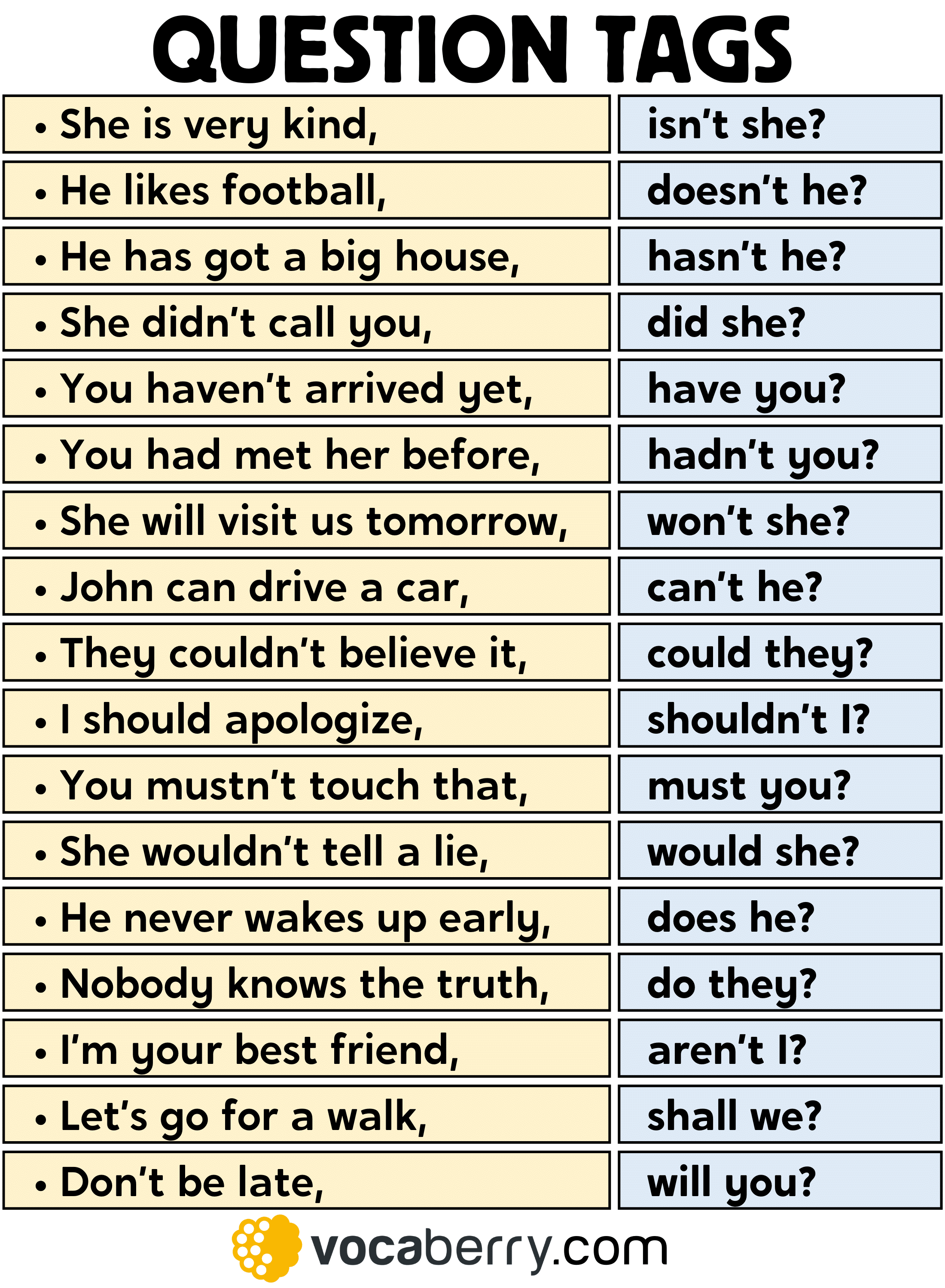
- Positive main clause → negative tag (aren't, doesn't, won't…)
- Negative main clause → positive tag (are, does, will…)
- Always use the auxiliary verb from the main clause in the tag.
- If there is no auxiliary, use do / does / did.
- Always replace the subject with a pronoun in the tag.
- Special: I am → aren't I?
- Special: Let's → shall we?
- Special: Negative words (nobody, never) → positive tag.
- Imperatives → will you? / won't you?
Good luck practising! Tag questions become natural with repetition.